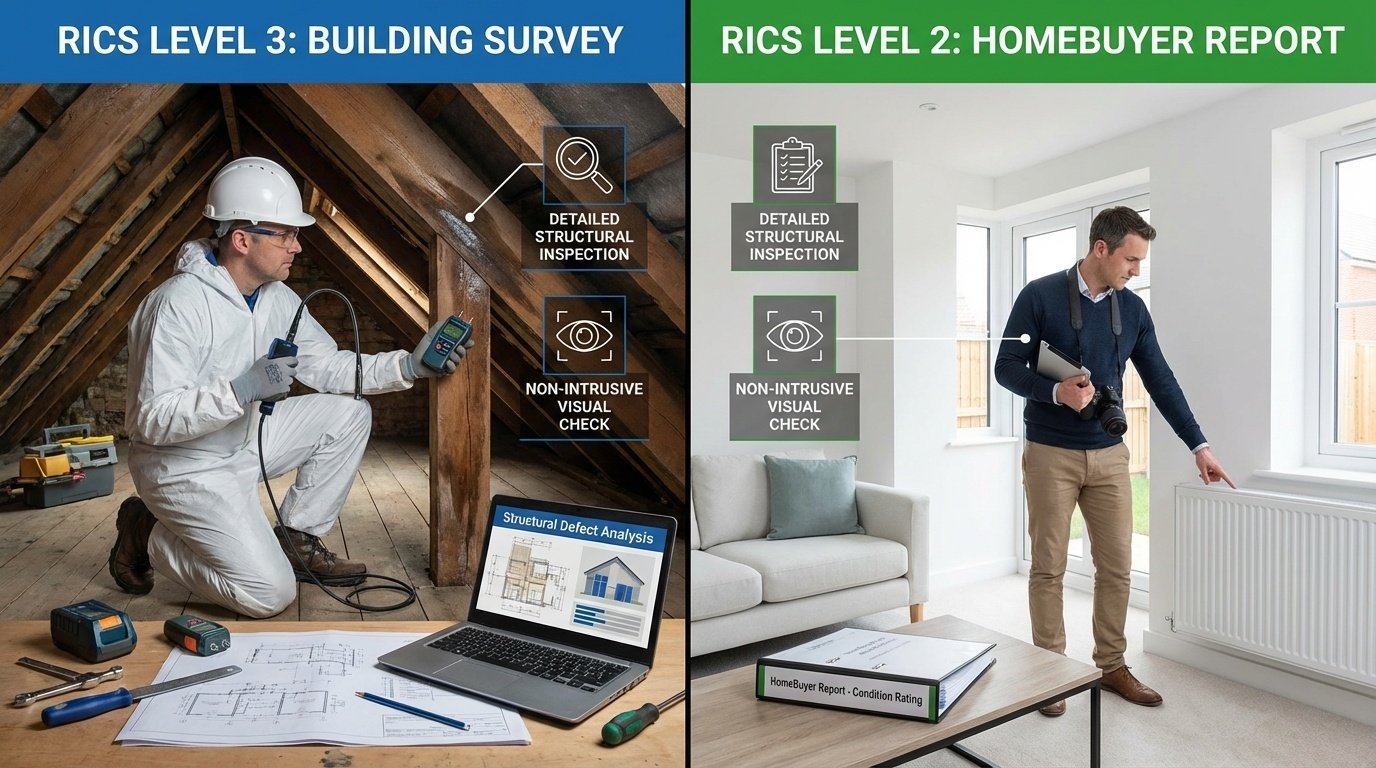
Choosing between a RICS Level 2 and Level 3 survey is one of the most important decisions you'll make when buying a property. Ashford Surveyors understand that the difference between these survey types can be confusing, and making the wrong choice could cost you thousands of pounds in unexpected repairs. This comprehensive guide from our chartered surveyors explains exactly what each survey type offers and helps you choose the right property survey for your needs.
Understanding RICS Survey Standards
The Royal Institution of Chartered Surveyors (RICS) sets professional standards for property surveys in the UK. RICS surveyors follow these standardized formats to ensure consistency and quality across the industry. When you hire Ashford Surveyors for a building survey or homebuyer report, you receive a professionally conducted inspection that meets strict RICS requirements.
RICS surveys come in three levels:
- Level 1 (Condition Report): Basic visual inspection suitable only for new or well-maintained properties
- Level 2 (HomeBuyer Report): Standard survey for conventional properties in reasonable condition
- Level 3 (Building Survey): Comprehensive inspection for older, unusual, or problematic properties
Most property buyers choose between Level 2 and Level 3, as Level 1 reports offer minimal detail and protection. Let's examine these two survey types in depth.
RICS Level 2 Survey (HomeBuyer Report) Explained
What Is a Level 2 Survey?
A RICS Level 2 survey, officially called a HomeBuyer Report, is the most popular survey type in the UK. It provides a detailed overview of a property's condition using a straightforward traffic-light rating system. Ashford Surveyors conduct hundreds of Level 2 surveys each year for buyers purchasing standard properties throughout Kent.
The Level 2 survey is designed for properties that are:
- Built using conventional construction methods
- In reasonable condition overall
- Constructed after 1900
- Without major alterations or extensions
- Not listed buildings
What's Included in a Level 2 HomeBuyer Report?
When our chartered surveyors conduct a Level 2 survey, we examine all accessible areas of the property and provide:
- Traffic-light condition ratings for every element (red = urgent action needed, amber = needs attention, green = no issues identified)
- Visual inspection of the structure, exterior, interior, services, and grounds
- Identification of major defects affecting value or safety
- Advice on repairs and estimated urgency
- Market valuation of the property (if requested)
- Reinstatement cost for insurance purposes
- Standardized report format that's easy to understand
- Legal issues such as guarantees, warranties, and building regulation compliance
A Level 2 survey is non-invasive, meaning our surveyors don't move furniture, lift carpets, or access areas that aren't readily available. We assess what we can see during a thorough visual inspection.
Level 2 Survey Limitations
While comprehensive for standard properties, Level 2 surveys have limitations:
- Limited inspection of inaccessible areas (behind walls, under floors)
- No detailed analysis of structural defects
- Brief commentary rather than extensive descriptions
- May recommend further specialist investigations for identified issues
I once conducted a Level 2 survey for a buyer purchasing a 1980s detached house in Maidstone. The property appeared well-maintained, and our visual inspection revealed only minor maintenance issues. However, when I noticed slight cracking near the rear extension, I recommended a structural engineer's assessment. That additional investigation uncovered foundation movement requiring £8,000 of repairs. The Level 2 survey flagged the concern, allowing the buyer to make an informed decision and negotiate accordingly.
Cost of a Level 2 Survey
RICS Level 2 surveys typically cost between £400-£900 depending on property size and location. For a three-bedroom semi-detached house in Kent, you can expect to pay around £500-£650. This represents excellent value considering the protection it provides against unexpected repair costs.
RICS Level 3 Survey (Building Survey) Explained
What Is a Level 3 Survey?
A RICS Level 3 survey, formerly called a Full Structural Survey or simply Building Survey, is the most comprehensive property inspection available. Ashford Surveyors recommend Level 3 surveys for properties with unique characteristics, visible problems, or when buyers need detailed information for renovation planning.
Level 3 surveys are ideal for:
- Properties built before 1900 (Victorian, Georgian, older)
- Listed buildings or properties in conservation areas
- Buildings of unusual construction (timber frame, thatched roof, etc.)
- Properties in poor condition or with visible defects
- Homes you plan to renovate or alter significantly
- Large or complex properties
- Properties that have had major structural alterations
What's Included in a Level 3 Building Survey?
A Level 3 building survey from our RICS surveyors includes:
- Detailed inspection of all accessible areas, including roof spaces, cellars, and outbuildings
- In-depth analysis of construction, materials, and condition
- Comprehensive report describing every element in detail
- Identification and diagnosis of defects with explanation of causes
- Repair recommendations with advice on methods and relative urgency
- Maintenance guidance for ongoing care
- Technical descriptions of construction and materials
- Assessment of risks and implications of identified issues
- Optional valuation (not included as standard but can be added)
Unlike Level 2 surveys, Level 3 reports don't use traffic-light ratings. Instead, our chartered surveyors provide detailed written descriptions and professional opinions about every aspect of the property's condition.
Level 3 Survey Thoroughness
During a Level 3 survey, our surveyors may:
- Inspect roof spaces and check roof structure closely
- Examine floor levels for structural movement
- Investigate damp or moisture issues in detail
- Check cavity wall construction and insulation
- Assess drainage and external areas thoroughly
- Identify risks from trees or vegetation
- Evaluate service installations (heating, electrics, plumbing)
- Investigate visible defects to determine causes
I remember conducting a Level 3 survey on a beautiful Victorian villa in Canterbury. The property was a potential renovation project for a buyer with ambitious plans. Our comprehensive inspection revealed that while the property had significant charm, it also had serious issues: the roof structure needed complete renewal, rising damp affected multiple walls, and the electrical system was dangerous. Our detailed report provided the buyer with a complete understanding of required works, enabling accurate budgeting. The project ultimately succeeded because the buyer knew exactly what they were taking on.
Cost of a Level 3 Survey
RICS Level 3 building surveys typically cost £600-£1,500 depending on property size, age, and complexity. A Victorian three-bedroom terrace in Kent might cost £750-£950, while a large period property could exceed £1,200. The investment is worthwhile for complex or problematic properties where detailed knowledge is essential.
Key Differences: Level 2 vs Level 3 Comparison
Comparison Table
| Feature | Level 2 (HomeBuyer Report) | Level 3 (Building Survey) |
|---|---|---|
| Property Type | Conventional properties in reasonable condition, built post-1900 | Older, unusual, or problematic properties; renovations |
| Inspection Depth | Visual inspection of accessible areas | Comprehensive examination including detailed investigation |
| Report Format | Standardized traffic-light system, brief comments | Detailed descriptive report with technical analysis |
| Valuation | Included as standard | Optional extra |
| Repair Advice | Basic guidance on urgency and type | Detailed recommendations on methods and options |
| Cost Range | £400-£900 | £600-£1,500+ |
| Report Length | 15-25 pages | 30-50+ pages |
| Best For | First-time buyers, standard properties, good condition homes | Period properties, renovation projects, unusual construction, visible issues |
Which Survey Should You Choose?
Choose a RICS Level 2 Survey If:
- You're buying a conventional property built after 1900 in reasonable condition
- The property appears well-maintained with no obvious major issues
- It's a standard construction (brick/block walls, tiled/slate roof)
- You're a first-time buyer purchasing a typical family home
- You want good value while still getting professional advice
- The property is a modern flat or apartment in good order
Example: A 1990s three-bedroom semi-detached house in Ashford that's been well looked after. It has modern double glazing, a relatively new boiler, and no visible structural issues. A Level 2 survey would identify any hidden problems while providing excellent value.
Choose a RICS Level 3 Survey If:
- You're buying a property built before 1900 (Victorian, Georgian, or older)
- The building has unusual construction (timber frame, thatched roof, cob walls)
- You've noticed visible defects like cracks, damp, or structural movement
- It's a listed building or in a conservation area
- You plan to renovate or extend significantly
- The property has had major alterations or extensions
- It's been empty for a long time or poorly maintained
- You want maximum detail for peace of mind
Example: A charming 1880s Victorian cottage in Canterbury with original features, solid walls, and a slate roof. You plan to renovate the kitchen and bathroom. A Level 3 survey would provide comprehensive detail about the property's condition and help plan renovation work safely.
Decision-Making Flowchart
Question 1: Is the property built before 1900?
YES → Consider Level 3
NO → Continue to Question 2
Question 2: Are there visible defects or concerns?
YES → Level 3 recommended
NO → Continue to Question 3
Question 3: Do you plan major renovations?
YES → Level 3 recommended
NO → Continue to Question 4
Question 4: Is it conventional construction in reasonable condition?
YES → Level 2 is suitable
NO → Level 3 recommended
Real-World Examples from Ashford Surveyors
Case Study 1: When Level 2 Was Perfect
A first-time buyer contacted Ashford Surveyors about a 2005-built townhouse in Maidstone. The property looked immaculate, with modern fixtures and apparent good maintenance. We recommended a Level 2 survey as the property fit the criteria perfectly.
Our HomeBuyer Report identified some minor issues: guttering needing attention, a small roof tile slippage, and recommendations for service boiler servicing. The traffic-light system made it clear these weren't urgent problems. The buyer proceeded confidently, addressed the minor issues after purchase, and has had no surprises. The £550 survey cost provided exactly the right level of protection.
Case Study 2: When Level 3 Was Essential
A couple planning to renovate an 1890s end-terrace in Canterbury requested a survey. Although they initially considered Level 2, we strongly recommended Level 3 given the property's age and their renovation plans.
Our comprehensive Level 3 building survey uncovered significant issues: the rear extension had inadequate foundations, roof timbers showed beetle infestation requiring treatment, and rising damp affected ground floor walls. Our detailed report provided specific repair recommendations and helped the buyers budget accurately. They negotiated a £20,000 price reduction and successfully completed their renovation with no nasty surprises. The £850 survey cost was money extremely well spent.
Case Study 3: When the Wrong Choice Was Made
Unfortunately, we sometimes see the consequences when buyers choose inadequate surveys. One client purchased a 1920s semi-detached property based only on a mortgage valuation. Shortly after moving in, they discovered serious problems: structural movement in the rear extension, outdated electrical systems, and extensive wood rot.
They contacted Ashford Surveyors for advice after the fact. We conducted a retrospective Level 3 survey that identified £35,000 of essential repairs. Had they commissioned a proper survey before purchase, they could have negotiated or made an informed decision not to proceed. This expensive lesson demonstrates why professional surveys are essential.
Frequently Asked Questions
Can I upgrade from Level 2 to Level 3 if concerns are found?
Yes, if our chartered surveyors identify significant concerns during a Level 2 survey, we may recommend upgrading to Level 3 or commissioning specialist investigations. It's better to discover this early. However, it's more cost-effective to choose the right survey type initially. If you're uncertain, Ashford Surveyors offer pre-survey consultations to help you decide.
Is a Level 3 survey worth the extra cost?
For properties that need comprehensive assessment—older buildings, unusual construction, visible problems, or renovation projects—Level 3 surveys provide exceptional value. The detailed information helps you budget accurately, negotiate effectively, and avoid expensive surprises. Many clients tell us their Level 3 survey saved them tens of thousands of pounds by identifying issues before purchase.
Do Level 2 surveys include valuations?
Yes, RICS Level 2 HomeBuyer Reports include market valuations and insurance reinstatement costs as standard. Level 3 Building Surveys don't include valuations automatically, but you can add one for an additional fee. Most buyers find the valuation helpful for negotiating or confirming the purchase price is reasonable.
How long do survey reports take?
At Ashford Surveyors, we typically deliver Level 2 reports within 5-7 working days of the inspection. Level 3 reports take slightly longer—usually 7-10 working days—due to the comprehensive nature and detail required. Urgent inspections can sometimes be arranged for an additional fee if your purchase timeline is tight.
Can surveyors move furniture or lift carpets?
Neither Level 2 nor Level 3 surveys involve moving furniture, lifting carpets, or accessing areas that aren't readily available. Surveyors assess what's visible during a thorough inspection. If we suspect issues beneath coverings, we'll note this in the report and may recommend further investigation. You can arrange for furniture to be moved or carpets lifted before the survey if you wish.
What if the survey finds major problems?
If our survey identifies significant defects, you have several options: negotiate a price reduction to cover repair costs, request the seller fix issues before completion, withdraw from the purchase, or proceed with full knowledge of required works. Our RICS surveyors provide clear guidance on the severity and implications of any problems found, helping you make informed decisions.
Are there properties that need more than Level 3?
In some cases, Level 3 surveys may identify issues requiring specialist investigation: structural engineers for serious movement, damp specialists for complex moisture problems, electrical surveys for dated wiring, or arboricultural surveys for tree-related risks. Ashford Surveyors coordinate with trusted specialists when needed and can arrange these additional investigations on your behalf.
Making Your Final Decision
Choosing between RICS Level 2 and Level 3 surveys depends on your specific property and circumstances. As a general rule:
- Level 2 is ideal for conventional properties built after 1900 in good condition
- Level 3 is essential for older, unusual, or problematic properties
If you're uncertain which survey type is right for your property purchase in Kent, contact Ashford Surveyors for expert advice. Our experienced chartered surveyors can discuss your specific property and circumstances, recommending the most appropriate survey level. We'd rather you invest in the right survey initially than discover you needed more comprehensive assessment after problems emerge.
Remember, a property survey is not an expense—it's an investment in protecting what's likely your biggest financial commitment. The cost of a thorough survey is minimal compared to the potential cost of unexpected structural repairs or hidden defects.
Why Choose Ashford Surveyors?
When you commission a property survey from Ashford Surveyors, you benefit from:
- RICS accredited surveyors with extensive local knowledge of Kent properties
- Clear, comprehensive reports written in plain English
- Thorough inspections that identify issues other surveyors might miss
- Honest advice about property condition and required works
- Competitive pricing with no hidden fees
- Fast turnaround to keep your purchase on track
- Post-survey support to answer questions and explain findings
We've surveyed thousands of properties throughout Ashford, Maidstone, Canterbury, and across Kent. Our local expertise means we understand regional property characteristics, common issues, and specific risks. We're not just surveyors—we're your professional advisors helping you make confident property decisions.
Book Your RICS Property Survey Today
Contact Ashford Surveyors for expert Level 2 or Level 3 surveys throughout Kent. Get professional advice from qualified chartered surveyors.
Request Survey Quote